Operation
Veronte Autopilot KAI performs 100% autonomous flight control through all the mission phases, from take off and cruise to landing or terminal phase, allowing the operator to take manual control on pilot demand or to operate the vehicle in fly-by-camera mode at any time during the operation.
Flight Control
The flight control system provides a universal GNC architecture, compatible with any airframe and developed under the DO-178C and DO-254 standards.
Its open architecture allows the definition of custom control laws, control phases, automatic routines and failsafes, so the system can be adapted to any mission profile or vehicle layout through model based design.
Types of operations
Veronte Autopilot KAI is a dual-use product: the same unit can be configured for industrial and for security applications, each one focused on a different core capability.
Industrial Applications
In industrial configurations, the miniaturized form factor and the embedded computer vision enable high autonomy across a variety of complex commercial applications, on fixed-wing, multirotor, helicopter, hybrid VTOL and USV platforms:
- GNSS denied localization: vision-based navigation to ensure mission safety and avoid signal loss during critical tasks.
- Target tracking: AI-driven algorithms for the high precision tracking of moving assets.
- Integrated RTK precision: centimeter-level positioning for precise navigation to the mission zone.
- Moving vehicle operations: autonomous takeoff and landing from ground or maritime mobile platforms.
- Swarm coordination: simultaneous control of multiple units with decentralized decision-making.
- Fly-by-camera: flight guided by the pointing direction of the camera or gimbal.
Loitering Munition
In Loitering Munition configurations, the unit provides 100 % autonomous operation in GNSS denied environments, optimized for one-way mission profiles:
-
GNSS denied navigation: embedded SLAM technology to estimate the position from the images captured by the onboard cameras when the satellite navigation signal is degraded or unavailable, complemented with 4G/LTE triangulated positioning and LEO positioning (RF PNT), and with the sensor fusion of the IMU, barometric and magnetic data. The architecture is hardened to detect and overcome jamming and spoofing attempts.
The vision-based navigation operates in two modes:
- Pre-mapped area: the system uses the loaded maps for positioning, without accumulated drift.
- Unmapped area: the system employs SLAM (Simultaneous Localization and Mapping), keeping a drift rate below 1 % of the distance travelled.
-
Terminal accuracy: real time AI computation of the lead-pursuit trajectory, with user selectable impact angles for maximum effect on the target.
- Camera guided control: fly-by-camera mode in which the pointing of the onboard camera is translated into flight commands, so the airframe follows the camera focus.
- Autonomous Target Engagement (ATE): neural network algorithms trained with pre-loaded threat libraries to automatically identify, classify and isolate specific tactical targets, without an active datalink or continuous operator input.
- Tactical stealth: specialised silent approach modes, including communications silence and full stealth glide, which reduce the acoustic and electromagnetic signatures during the final approach.
- Swarming: scalable architecture supporting synchronised multi-vehicle operations for coordinated saturation attacks.
- Payload safety: redundant warhead arming protocols to guarantee a controlled activation of the payload.
C-UAS Interception
In Counter-UAS configurations, focused on point and track, the unit is optimized for the high speed interception of agile threats, fusing aerospace grade reliability with AI driven neutralization:
- Radar slaved navigation: integrated Slew-to-Cue protocols for the real time target handover from ground radar, fusing the external telemetry with the internal sensors to maintain an accurate interception vector.
- High dynamic GNC: specialised guidance and control laws optimized for aggressive turns and high-g terminal manoeuvres, designed to survive launch loads above 35 g.
- AI threat neutralization: high frame rate computer vision dedicated to identifying tactical signatures and to compute the autonomous lead pursuit of high speed moving threats. The ATE algorithms classify the threats against the pre-loaded libraries, so the interception can be completed without an active datalink.
Data Wipe and Encryption
All the configuration files, custom control logic and operational profiles stored in the onboard non-volatile memory are secured and hardware-bound with AES-256 encryption, so the configuration data remains unreadable even if the unit is physically captured.
Every data packet exchanged between the autopilot and the control station is encrypted in real time and validated with secure cryptographic handshakes across all the telemetry and command datalink channels, which prevents eavesdropping, man-in-the-middle data manipulation and adversarial command injection.
The data purge feature allows the instant wiping of the sensitive onboard data, such as the flight logs and the mission parameters. It can be triggered manually by the operator or automatically on pre-defined fail-safe conditions, such as a loss of link in a high-risk zone or a physical tampering attempt.
Operation Architectures
Veronte Autopilot KAI allows for a wide variety of communication and control solutions to adapt to each mission and platform specifications.
Tip
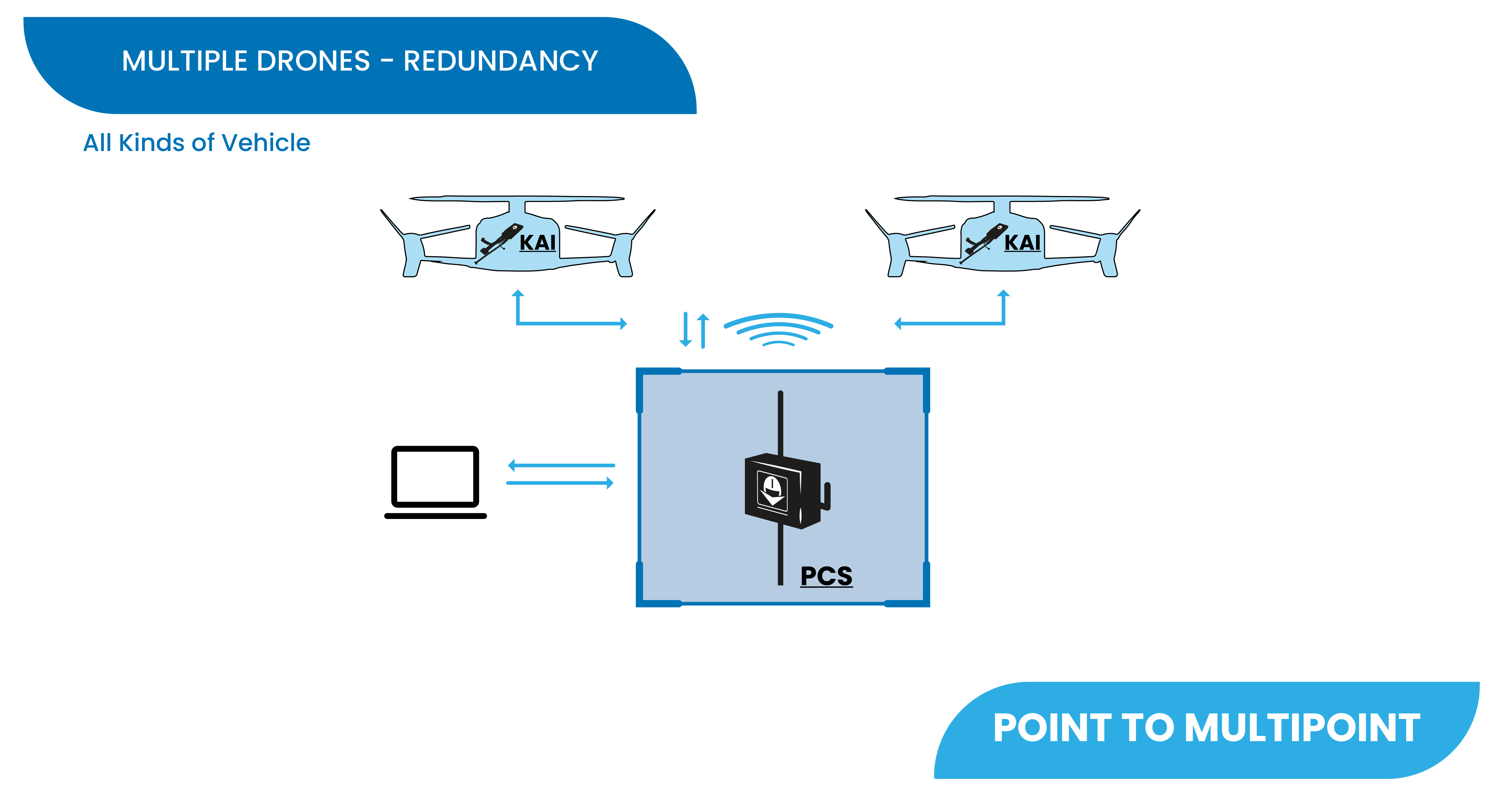
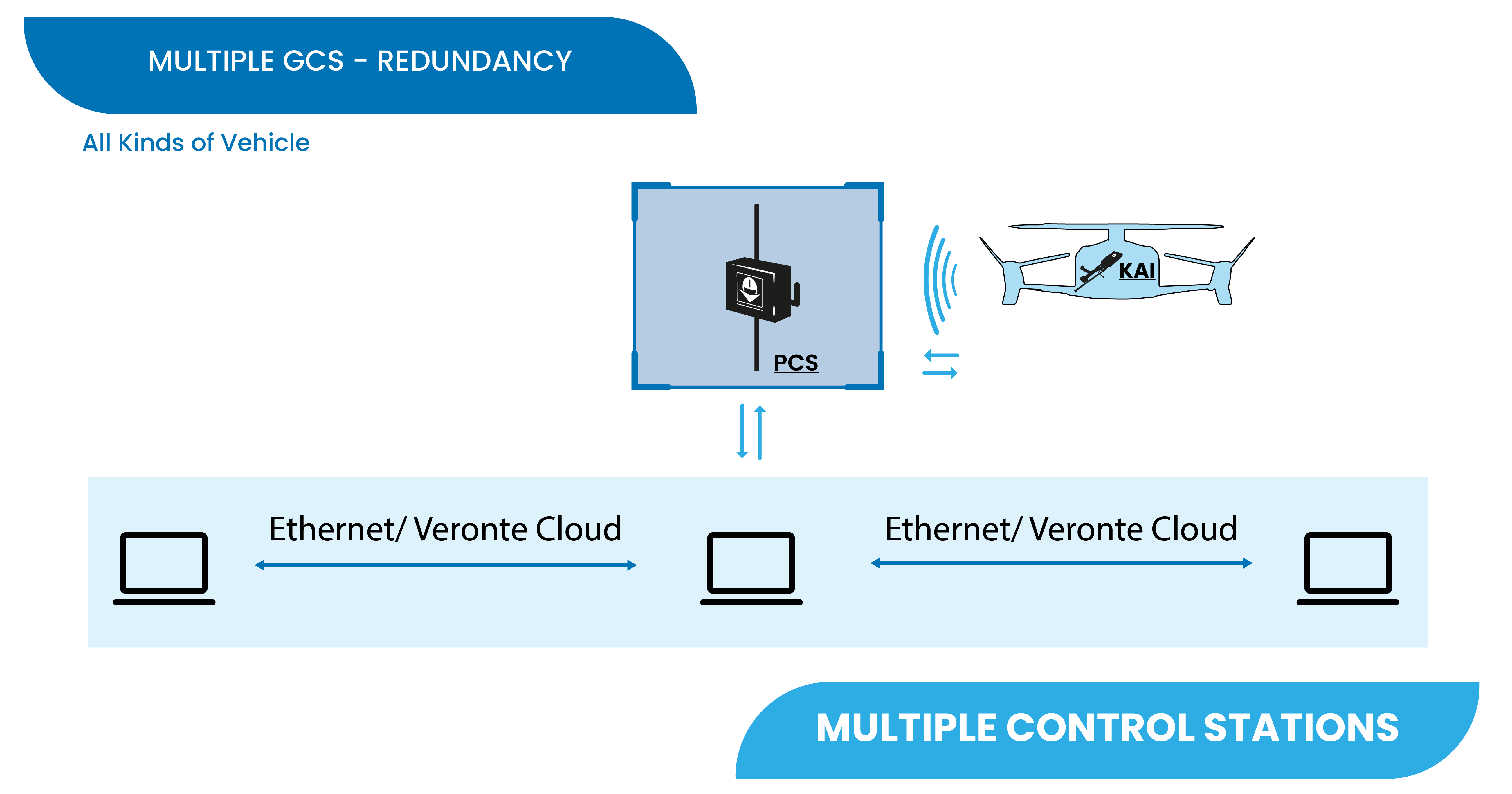
Most of the following diagrams can be used independently or combined, to create redundant systems or backup solutions.
Control Setups
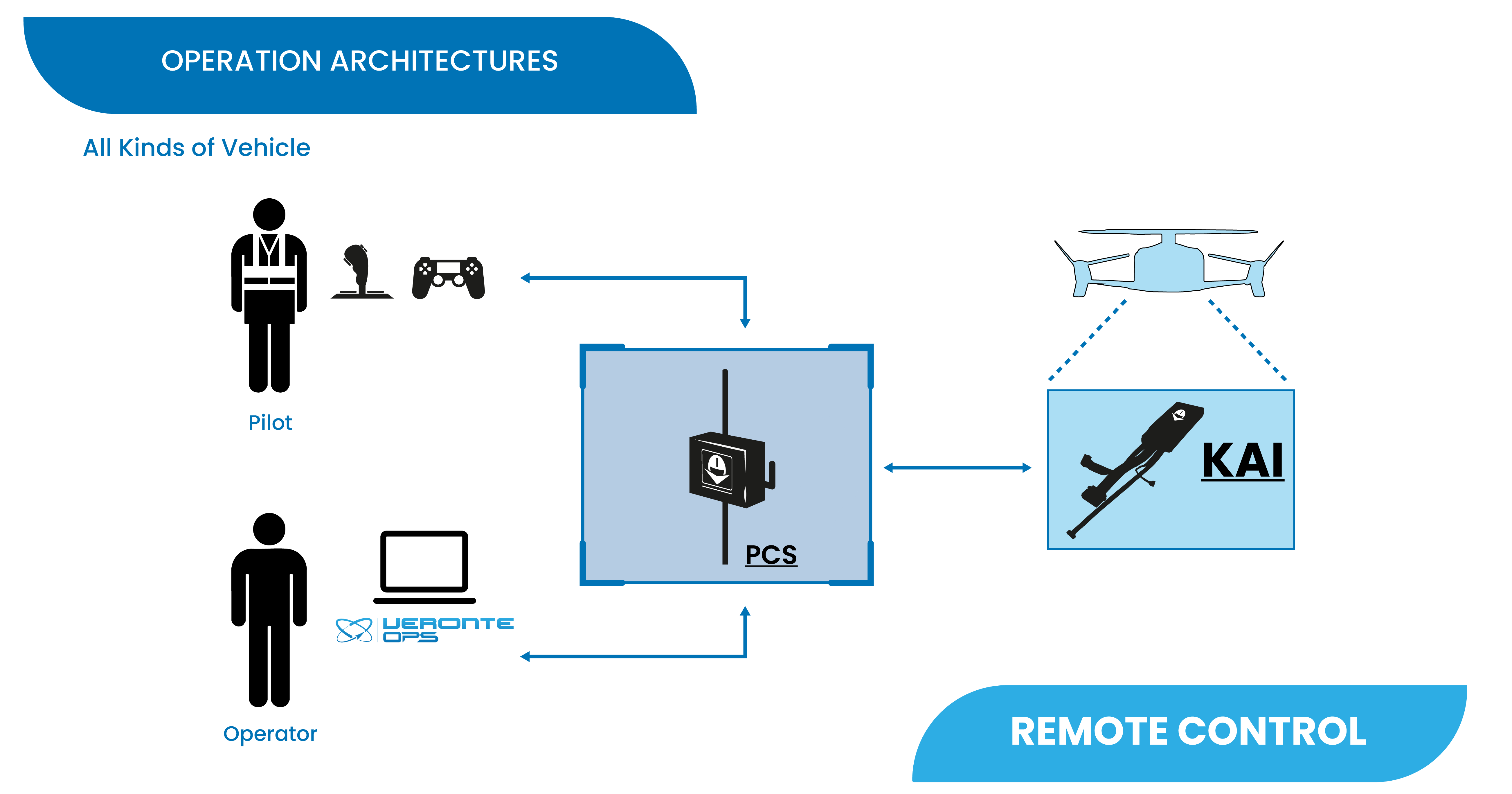
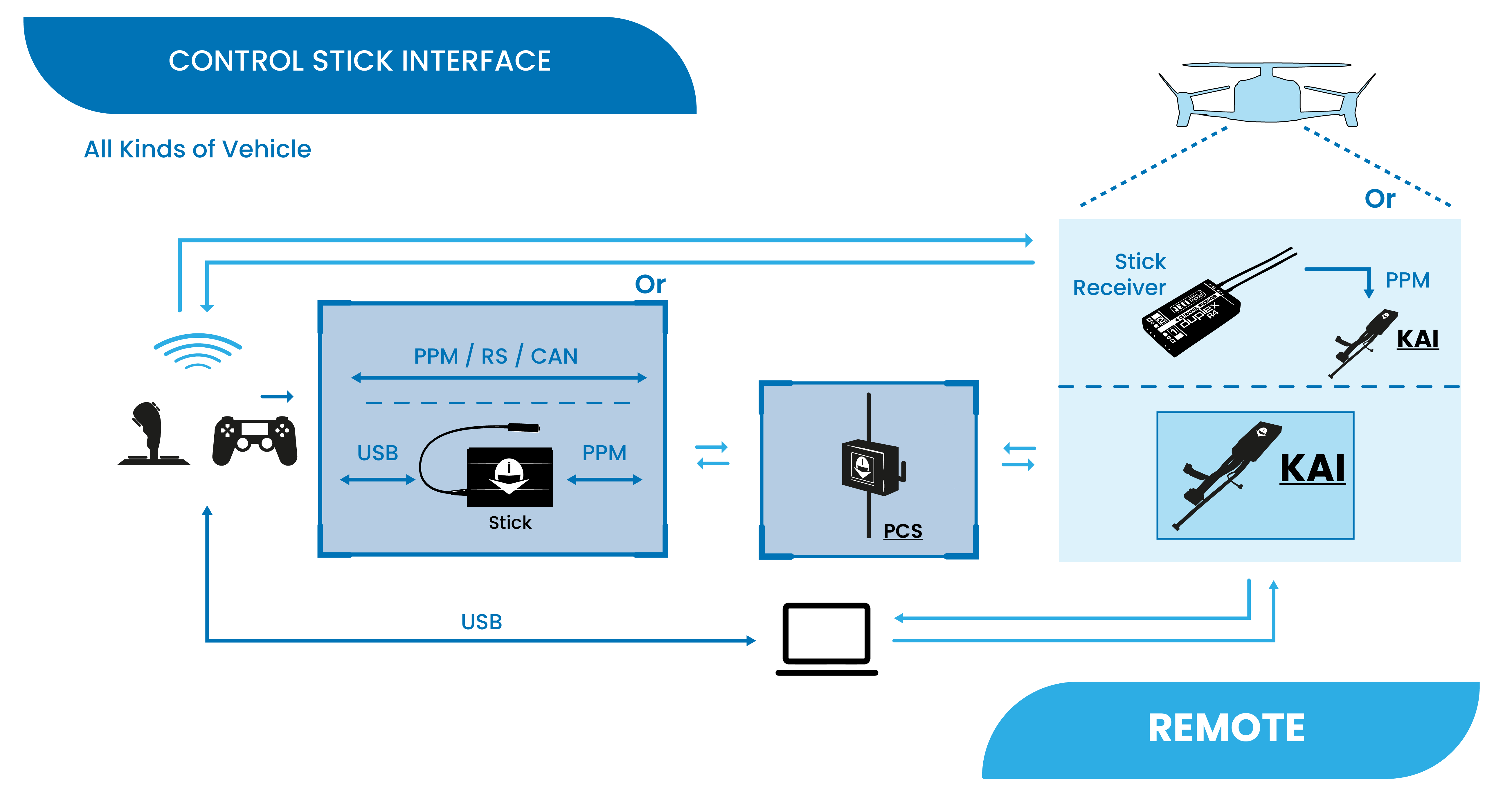
Remote control: an operator commands the vehicle from the control station with Veronte Ops, while a safety pilot can take control at any time through a stick connected to the ground unit (PCS).
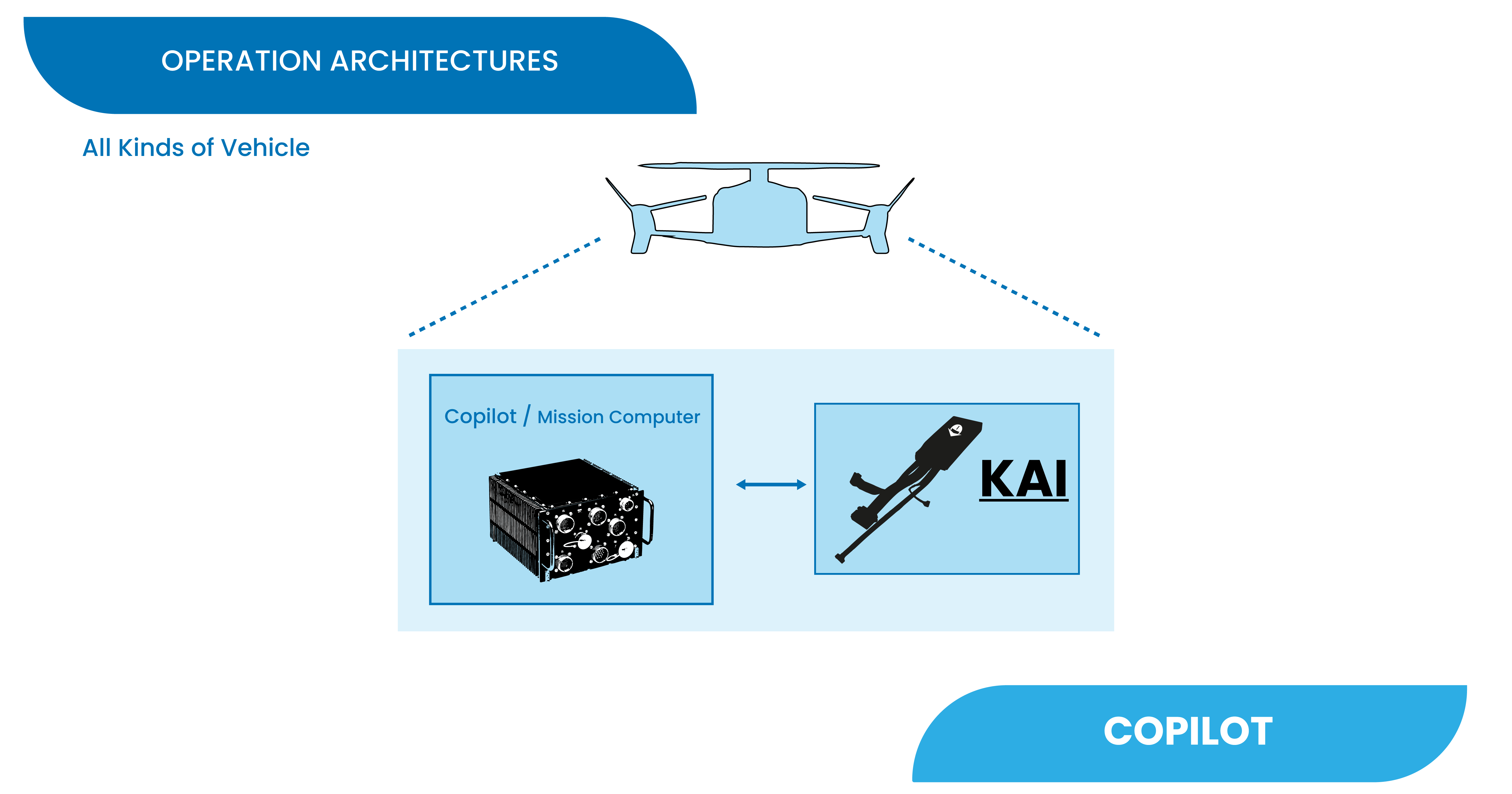
Copilot: the autopilot works together with an onboard mission computer, which handles the mission specific or advanced processing.
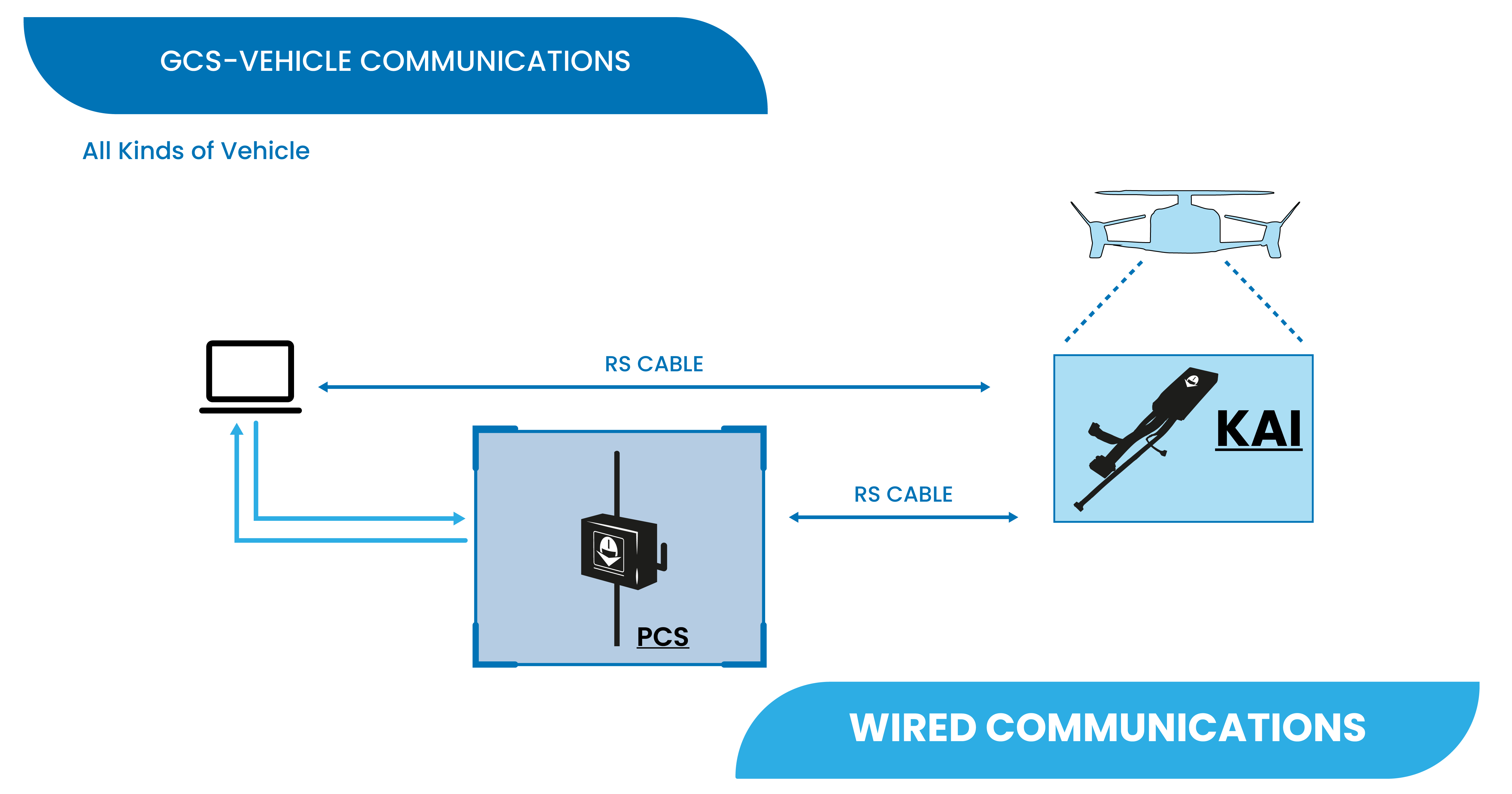
GCS-Vehicle Communications
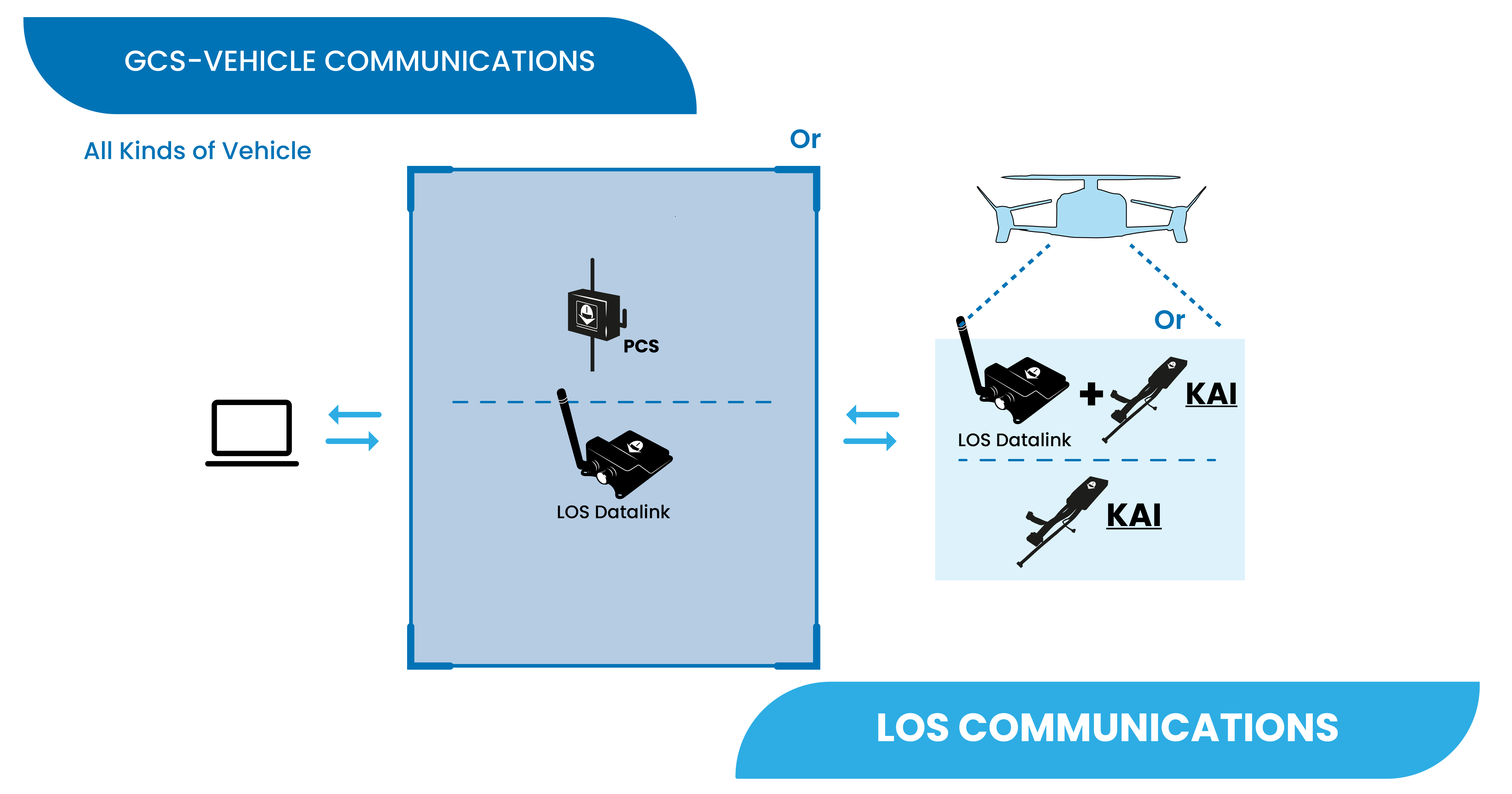
LOS communications: the control station (PCS or an external LOS datalink) links directly with the onboard unit.
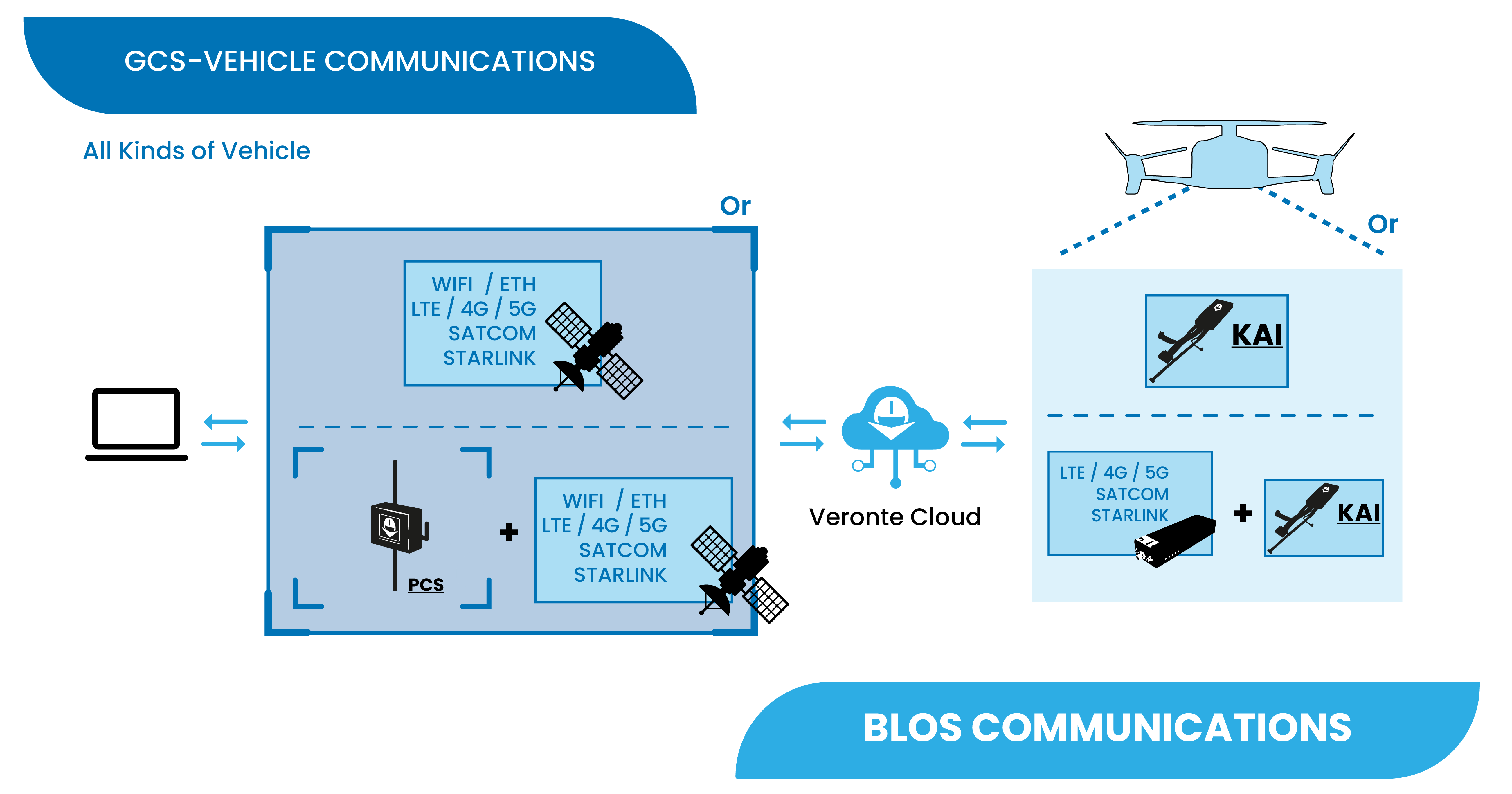
BLOS communications: Veronte Cloud links the control station and the vehicle through external LTE/4G/5G, Satcom or Starlink modules. These methods can be used on both sides, switched or combined for redundancy.
Wired communications: the control station is directly connected to the onboard autopilot by cable.
Control Stick Interface
Remote stick: the stick is connected to the control station via PPM, RS or CAN, either directly or through a Veronte Stick that converts USB to PPM. A stick receiver onboard provides a backup manual channel.
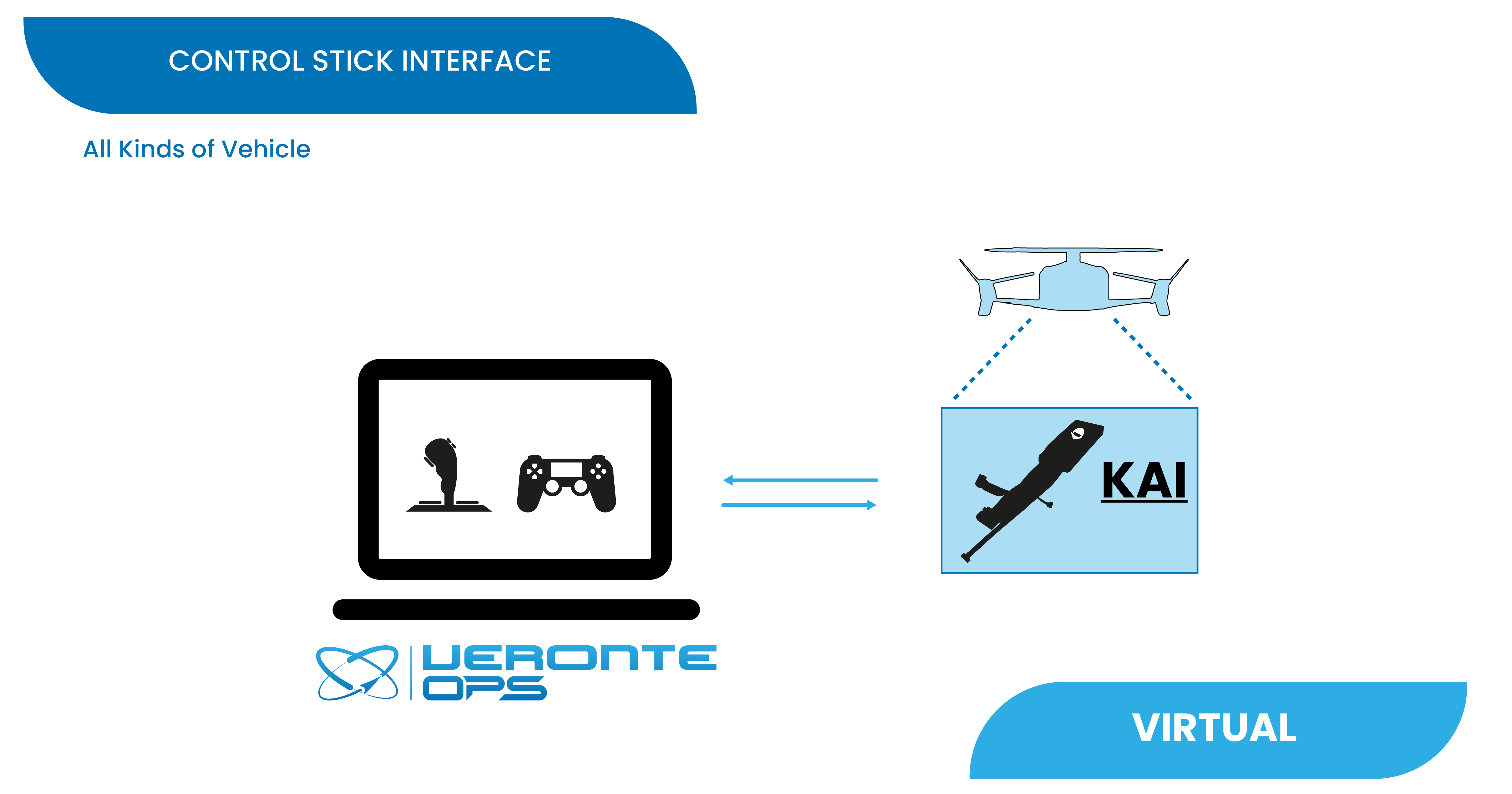
Virtual stick: any device able to provide control reference values through RS232, RS485, ADC or CAN can be used as a stick controller.
Multiple Vehicles and Control Stations
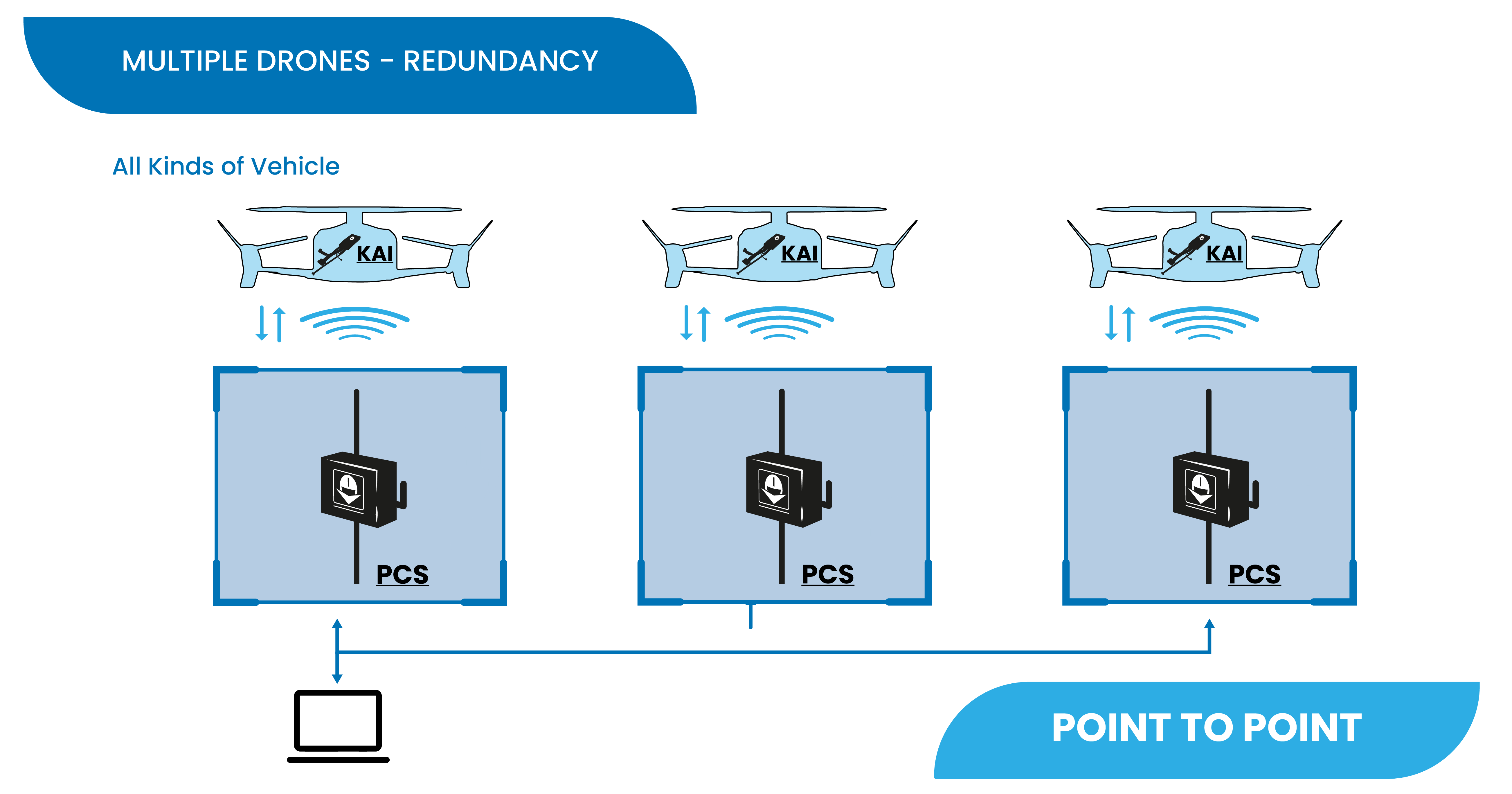
Point to point: standard multiplatform setup, with one ground unit per vehicle.
Point to multipoint: several platforms managed with a single radiolink.
Multiple control stations: for long range operations with several LOS stations, the PCs are connected through Ethernet or Veronte Cloud.
Operating Life
Important
By default, Veronte Autopilot KAI is limited to 3 flights. Once this limit is reached, the unit will not be able to restart.
A permanent license is also available for industrial applications and for training / demo units.
© 2026 Embention. All rights reserved.