Cameras
Veronte Autopilot KAI processes the video stream of the onboard cameras in its AI computer vision layer, which performs the vision based navigation (SLAM), the target selection and follow and the computer vision homing during the terminal phase.
Two different TechNexion FPD-Link III cameras are used, each one dedicated to a different function:
- TechNexion VLS-FPD3-AR0145-M-S78-IR: camera for the Visual Odometry (VO).
- TechNexion VLS-FPD3-AR0234-C-S83-IR: camera for the Autonomous Target Engagement (ATE).
1. TechNexion VLS-FPD3-AR0145-M-S78-IR (VO)
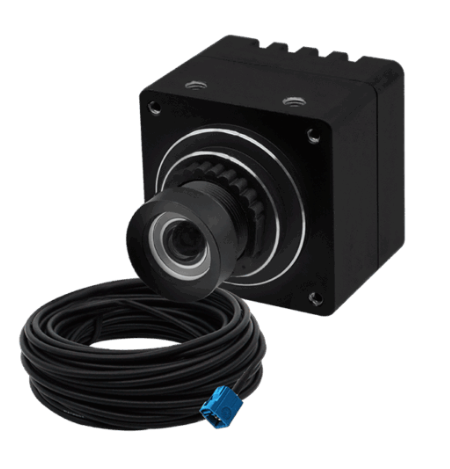
The TechNexion VLS-FPD3-AR0145-M-S78-IR is an enclosed global shutter camera with an FPD-Link III serial interface. Its high frame rate and ultra-short exposure make it suitable for capturing fast-moving scenes, which is why it is used for the visual odometry.
| Specification | Value |
|---|---|
| Sensor | onsemi AR0145, 1/4.3" optical format, 1280 x 800 (1 MP), global shutter Pixel size 2.8 µm x 2.8 µm, monochrome |
| Maximum frame rate | 115 fps (YUV422-UYVY) at 1280 x 800, 1280 x 720 and 640 x 480 |
| Output formats | YUV422-UYVY, RGB888, RGB565, RAW8, RAW10, RAW12 |
| Interface | FPD-Link III (TI DS90UB953 serializer) FAKRA SMB jack, Z-Code |
| Supply voltage | 10.8 to 26.4 V (Power over Coax) |
| Power consumption | ≤ 1.4 W ≤ 0.6 W (standby) |
| Lens | S-Mount (M12) D-FOV 78° IR-cut filter at 650 nm |
| Dimensions and weight | 29.5 mm x 29.5 mm x 28 mm, 45 g |
| Operating temperature | -30 to 70 ºC |
| Shock and vibration | 15 G half-sine, 11 ms 1 Grms random, 5 to 500 Hz |
| MTBF | 50,000 h |
2. TechNexion VLS-FPD3-AR0234-C-S83-IR (ATE)
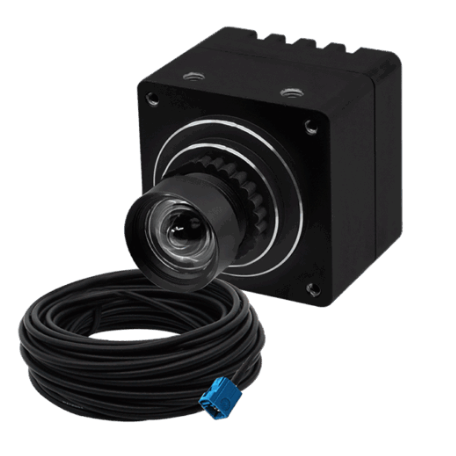
The TechNexion VLS-FPD3-AR0234-C-S83-IR is an enclosed global shutter camera with an FPD-Link III serial interface. Its higher resolution provides the detail required for the target selection and follow and for the computer vision homing of the terminal phase.
| Specification | Value |
|---|---|
| Sensor | onsemi AR0234, 1/2.6" optical format, 1920 x 1200 (2.3 MP), global shutter Pixel size 3.0 µm x 3.0 µm, colour |
| Maximum frame rate | 60 fps (YUV422-UYVY) at 1920 x 1200 and 1920 x 1080 120 fps (YUV422-UYVY) at 1280 x 720 and 640 x 480 |
| Output formats | YUV422-UYVY, RGB888, RGB565, RAW8, RAW10, RAW12 |
| Interface | FPD-Link III (TI DS90UB953 serializer) FAKRA SMB jack, Z-Code |
| Supply voltage | 10.8 to 26.4 V (Power over Coax) |
| Power consumption | ≤ 1.5 W ≤ 0.1 W (standby) |
| Lens | S-Mount (M12) D-FOV 83° IR-cut filter at 650 nm |
| Dimensions and weight | 29.5 mm x 29.5 mm x 28 mm, 45 g, aluminium enclosure |
| Operating temperature | -30 to 70 ºC |
| Shock and vibration | 15 G half-sine, 11 ms 1 Grms random, 5 to 500 Hz |
| MTBF | 50,000 h |
2.1. Camera arrangement
Each camera is installed in the vehicle with a different orientation, according to its function:
-
VO camera (VLS-FPD3-AR0145-M-S78-IR), pointing to nadir: provides the images for the vision based navigation, from which the SLAM algorithm tracks the ground features to estimate the position of the vehicle in GNSS denied operations.
-
ATE camera (VLS-FPD3-AR0234-C-S83-IR), facing forward along the x axis of the aircraft: provides the images for the target selection and follow and for the computer vision homing of the terminal phase.
2.2. Wiring
Both cameras transmit the video and receive the power through a single coaxial cable with FAKRA (Z-Code) connectors, using FPD-Link III with Power over Coax. On the autopilot side, the FPD-Link III link is deserialized and delivered to the MIPI camera interface of Veronte Autopilot KAI.
Important
The Power over Coax supply must be within 10.8 to 26.4 V. Use FAKRA Z-Code coaxial cables rated for FPD-Link III and keep the cable length within the limits of the serializer/deserializer link.
2.3. Installation recommendations
- Mount both cameras rigidly to the airframe. Any relative movement between the camera and the autopilot degrades the visual-inertial fusion.
- Keep the field of view free of obstructions, such as propellers, landing gear or antennas.
- Install the cameras aligned with the aircraft axes whenever possible, and configure the mounting offset in the software.
- Protect the cable routing from vibration, keeping the wiring loose enough so that vibrations are not transmitted to the camera or to the autopilot.
© 2026 Embention. All rights reserved.