Hardware Installation
Mechanical
Veronte Autopilot KAI has a high level of miniaturization, which allows it to be integrated into all kinds of vehicles, maintaining compatibility across fixed-wing, multirotor, helicopter, hybrid VTOL and USV platforms. It is available in an OEM variant, with the bare PCBA for the maximum level of integration, and in a rugged variant, fully enclosed with a rugged coating that adds waterproof and anti-tamper protection, with 190 g as total weight.
Pressure lines
Veronte Autopilot KAI has two pitot pressure sensor inputs, which are in charge of determining both the dynamic pressure and the static pressure.
-
Pressure Intake
- Pressure intakes must be located in order to prevent clogging.
- Do not install pressure intakes on the propeller flow.
- Design pressure tubing path in order to avoid tube constriction.
-
Static Pressure
- It is not recommended to use inside fuselage pressure if it is not properly vented.
-
Pitot Tube
- Pitot tube must be installed facing the airflow.
- It is recommended to install it near the aircraft's x axis in order to avoid false measures during manoeuvres.
- The internal barometers allow a direct connection to the vehicle's pitot tube using standard 2 mm tubing.
- For low-speed aircraft it is recommended at least 6.3 mm tubes to prevent any rain obstruction.
Location
The location of Veronte Autopilot KAI has no restrictions. It is only required to configure its relative position respect to the centre of mass of the aircraft and the GNSS antenna.
Orientation
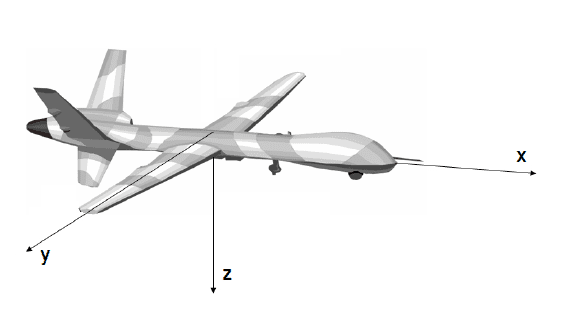
The orientation of Veronte Autopilot KAI has no restrictions either. It is only required to configure axes respect to the aircraft by means of a rotation matrix or a set of correspondences between axes.
Aircraft coordinates are defined by the standard aeronautical conventions, shown in the following figure.
Vibration Isolation
Although the Veronte Autopilot KAI rejects noise and high-frequency vibration modes with electronic filters, there may be situations where external isolation is needed. An optional Damping System can be ordered to reduce the aircraft vibrations to the KAI.
Note
The user should take into account that wiring should be loose enough so that vibrations are not transmitted to the Autopilot KAI.
Electrical
Power
Veronte Autopilot KAI requires an input power supply in the 18 to 34 V DC range and includes a redundant power supply, as well as ESD and reverse polarity protections.
Warning
Power out of range can cause irreversible damage to the system.
Mating Connectors
The standard connector of the Rugged variant is a Samtec type connector. The following mating solutions are available to connect the KAI to the platform:
| Solution | Description | Use |
|---|---|---|
| Standard flex |
Flex cable, 31 mm width x 30 cm length Male-male connectors |
KAI to board |
| Custom flex |
Flex cable, 31 mm width Male to custom connector |
KAI to vehicle |
| Breakout board |
Board with female connector USB and RJ45 connectors 41.50 x 73.6 mm |
KAI to standard connectors |
| Cable board |
Board with male or female connector Futaba connectors Through holes for cables |
KAI direct connection |
The custom flex solution is adapted to each customer and platform, and is available for orders from 1,000 units.
© 2026 Embention. All rights reserved.