CAN-FD A SETUP
CAN-FD A Setup panel allows for the management of communication on the CAN bus. The setup is divided into two main areas: reception filter management (Mailboxes) and communication speed settings (Baudrate*).
Mailboxes
In this tab, the user defines how the system filters and stores incoming messages from the bus. Since Veronte Autopilot 1x receives data on the CAN-FD bus, it is mandatory to configure mailboxes to temporarily store data until the system processes it. A mailbox can be configured for multiple CAN message IDs as long as the mask is correctly set and messages are sent with enough spacing for the core to process them.
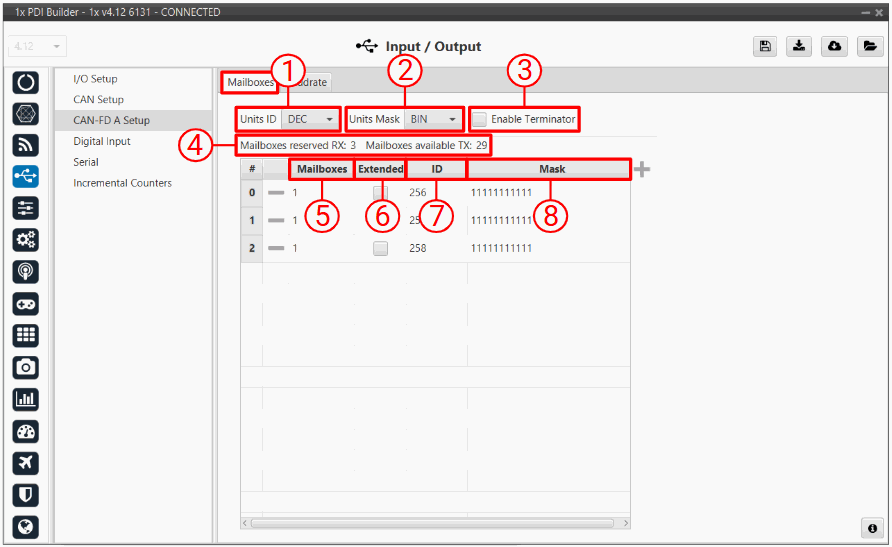
In order to add a mailbox, press the  icon.
icon.
Find below the configurable parameters:
-
Units ID: Units available are Decimal, Hexadecimal or Binary.
-
Units Mask: Units available are Decimal, Hexadecimal or Binary.
-
Enable Terminator: It allows enabling the internal CAN resistor.
Warning
If the function is not available for the autopilot version, the CAN resistance cannot be disabled.
-
Mailboxes reserved RX / available TX: Indicates the real-time distribution of resources. The system has a total of 32 physical mailboxes. Each row added to the reception table occupies hardware mailboxes, proportionally reducing the number of mailboxes available for transmission (TX).
-
Mailboxes: Number of mailboxes assigned to that ID.
-
Extended: If enabled, the frame format will be this, 'Extended', i.e. with a 29-bit identifier. Otherwise, the frame format 'Standard' (11-bit identifier) is set by default.
-
ID: 11-bits (Standard) or 29-bits (Extended) ID used to identify RX messages. The value set can be defined in different units, this is configured in (5).
-
Mask: This filter is configured for reception messages; received data will be stored on mailboxes where message ID coincides with mailbox ID.
Mask adds some flexibility on the reception, when comparing message with mailbox data, only the value of binary digits configured as 1 on the mask will be taken into account. The value set can be defined in different units, this is configured in (6).
For example, for a configuration mask: 11 000 and ID: 10 110, all incoming messages addressed to 10 XXX will be received in this mailbox.
Warning
Make sure that mask is set properly to be able to receive the desired CAN messages. The mask should be 11 bits for Standard frame format and 29 bits for Extended frame format.
More information about this can be found in How to calculate a mask - FAQ section of this manual.
Baudrate
The Baudrate tab allows users to define specific timing and speed parameters for the CAN-FD bus. Unlike standard CAN, the CAN-FD protocol distinguishes between two different bit rate phases: the arbitration phase and the data phase.
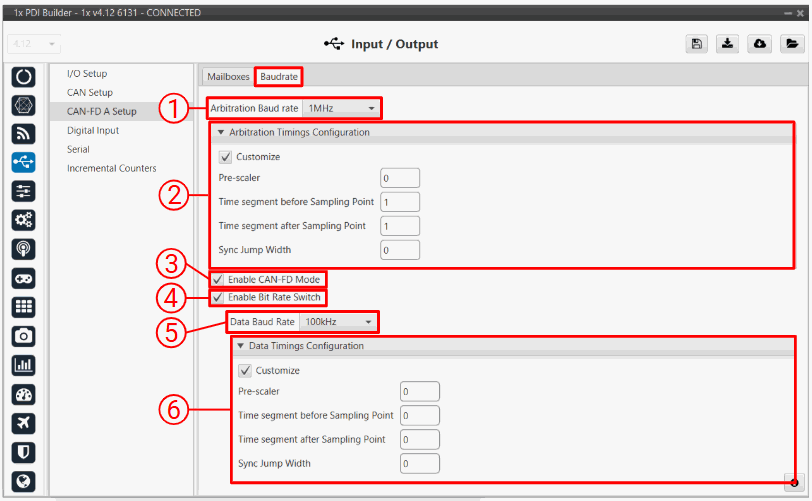
Find below the configurable parameters:
-
Arbitration Baud rate: A dropdown menu to select the base communication speed.
-
Arbitration Timings Configuration: By enabling the customize checkbox, users can manually define the low-level timing segments of the bit:
-
Pre-scaler: Sets the time quantum length.
-
Time segment before Sampling Point: Sets the duration of the phase preceding the sampling point; correct configuration ensures signal stability when the bit is read.
-
Time segment after Sampling Point: Defines the phase duration after the sampling point to manage propagation delays on the bus.
Tip
For stable communication, it is generally recommended to configure the timing segments so that the Sampling Point is located between 75% and 80% of the total bit duration.
-
Sync Jump Width: Specifies the maximum compensation the system can apply to resynchronize with other nodes in case of phase variations. 3. Enable CAN-FD Mode: This checkbox must be enabled to use the Flexible Data-rate frame format.
-
-
Enable Bit Rate Switch: When active, the bus will switch to a higher speed during the data payload section of the frame.
-
Data Baud Rate: Sets the high-speed rate for the data phase.
-
Data Timings Configuration: This section manages much higher bitrates and requires more precise settings for extremely shorter bits, with the aim of maximizing data transfer efficiency while maintaining signal integrity at high frequency.
The description of the configurable parameters is analogous to the one reported in the Arbitration Timings Configuration section.
© 2026 Embention. All rights reserved.